Choosing a remodeling contractor takes more than comparing photographs or the lowest estimates. Check credentials, compare proposals for the same scope, and ask how the work and decisions will be managed before signing an agreement.
California’s Contractors State License Board (CSLB) license lookup and contractor-selection guidance recommend getting at least three written bids and comparing them using identical plans, specifications, and scope. That is a useful starting point, but price is only one part of the decision. The goal is to understand which contractor gives you the clearest, most complete path from planning through construction.
1. Verify the Contractor’s License and Business Identity
Start with the CSLB license lookup. Confirm that the license is active and that the business name on the proposal matches the contractor you are considering.
Do not stop at seeing a license number on a website or proposal. CSLB specifically advises consumers to verify the current license status. You should also ask what insurance coverage the contractor carries and review the information available through the license record.
Ask who is legally responsible for the work you are hiring the company to perform.
2. Look for Experience With Projects Similar to Yours
A strong portfolio should show more than attractive finished rooms. Look for projects that are comparable to yours in scope, layout, construction complexity, or property type.
Ask to see examples of work involving the same kinds of decisions your project may require, such as:
- changing a kitchen or bathroom layout;
- opening or reframing walls;
- coordinating plumbing, electrical, or HVAC work;
- selecting cabinetry, tile, flooring, fixtures, or finishes;
- preparing plans or working through permit requirements;
- sequencing several trades within one remodel.
Local experience also matters, but avoid treating “Orange County experience” as a substitute for project-specific knowledge. Orange County includes multiple cities and unincorporated areas with different permitting authorities and procedures. A contractor should be able to identify the correct jurisdiction for your property rather than give a generic answer.
What Should a Real Remodeling Project Record Show?
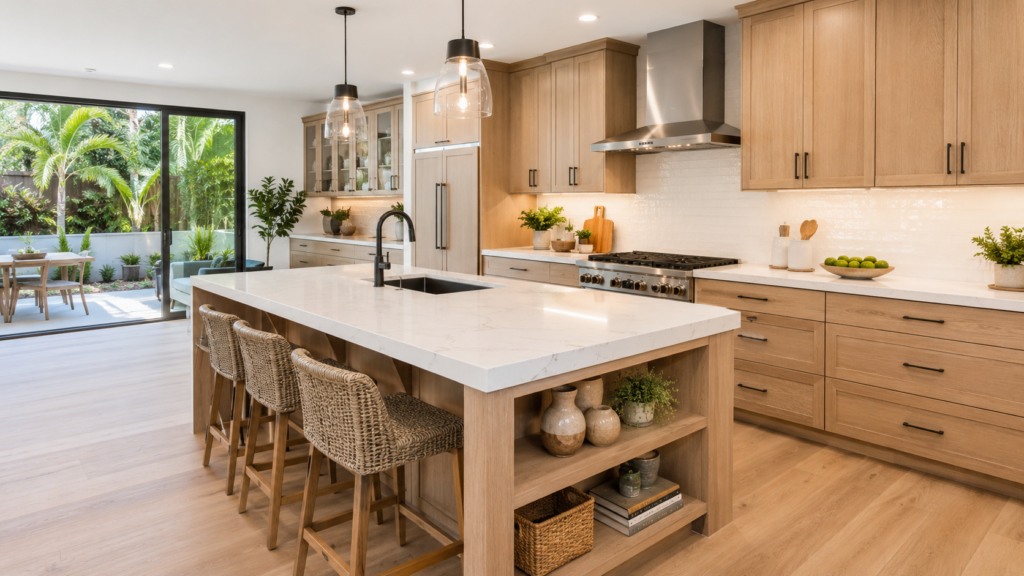
Finished photographs show visible details, but not every decision behind the work. Bud's Mission Viejo kitchen design record includes drawings and preliminary renderings. Separately, a Mission Viejo kitchen portfolio shows a finished kitchen with white cabinetry and a waterfall island. These examples help illustrate how cabinetry, island placement, storage and finishes can be considered together; they are not presented as the same project.
Ask for examples comparable to your proposed scope. Pictures alone do not establish permit approval, cost, schedule or contract terms; request relevant documentation separately.
3. Compare Written Bids on the Same Scope
CSLB recommends getting at least three written bids and warns against automatically choosing the lowest one. The comparison is only useful when the contractors are pricing the same project.
Before comparing totals, compare what each proposal actually includes. For a closer look, read what a remodeling estimate should include.
- Scope of work
- What is included, excluded, or still subject to investigation?
- Materials and selections
- Are products specified, or are there allowances that may change?
- Demolition and preparation
- Are protection, demolition, hauling, disposal, and site preparation included?
- Plans and permits
- Who is responsible for drawings, engineering, submittals, fees, corrections, and inspections where required?
- Trade coordination
- Who coordinates framing, plumbing, electrical, HVAC, waterproofing, finishes, and other work?
- Schedule assumptions
- What must be selected, approved, ordered, or inspected before each phase can proceed?
- Changes
- How are added, removed, or revised items documented and priced?
- Warranty
- What coverage is offered, what is excluded, and which written terms control?
A lower bid may be legitimate, but it can also reflect a narrower scope or different assumptions. If one proposal is substantially different from the others, ask why before deciding.
4. Ask These Questions Before Hiring a Remodeling Contractor
A good contractor should be comfortable answering specific questions before you sign anything.
- Is your CSLB license active, and does the business name on this proposal match the license?
- Have you completed projects with a scope similar to mine?
- Who will be my main point of contact, and who manages the project day to day?
- What is included in the proposed scope, and what is specifically excluded?
- Are architectural drawings, structural engineering, permits, or inspections likely to be needed for this scope?
- How will requested changes or unexpected conditions be documented and priced?
- What decisions or material selections do I need to make before construction starts?
- How will schedule changes, access needs, inspections, and upcoming decisions be communicated?
- What payment schedule will apply, and what work or materials does each payment correspond to?
- What warranty applies to the work, and where are the written warranty terms?
Look for clear, specific answers rather than broad promises about speed, price, or a “stress-free” project.
5. Evaluate the Initial Consultation
A productive remodeling consultation should do more than produce a quick number.
The contractor should ask how the space is used now, what is not working, what you want to change, which features matter most, and whether the work affects adjoining rooms or building systems. Layout changes can affect plumbing, electrical, framing, ventilation, waterproofing, cabinetry, finishes, or structural conditions.
Good planning also identifies what is still unknown. Existing conditions cannot always be fully confirmed before demolition, and a responsible contractor should distinguish between verified scope, reasonable assumptions, and items that may require further investigation.
That kind of clarity is more valuable than a promise that there will never be changes or surprises.
6. Understand the Difference Between an Estimate and the Final Contract
A written bid or estimate helps you compare contractors. It is not a substitute for the final contract.
Current CSLB home-improvement-contract guidance explains current written home-improvement contract requirements. Review the current guidance for your project, including scope, materials, payment, responsibilities, changes and applicable warranties.
CSLB also states that, for typical home improvement contracts, the down payment generally cannot exceed $1,000 or 10% of the contract price, whichever is less. CSLB identifies a rare exception for contractors with a qualifying blanket performance and payment bond on file, so homeowners should verify the current rule and any claimed exception directly with CSLB.
Before signing, make sure verbal promises that matter to your decision are reflected in the written documents.
7. Clarify the Permit and Plan Path
Not every remodel requires the same permits, plans, or engineering. The requirements depend on the property, jurisdiction, and scope.
OC Development Services building-permit guidance covers building plan check and permitting for private properties in unincorporated Orange County, while incorporated cities generally operate through their own building departments. Interior remodels, additions, and electrical, HVAC, plumbing, or structural work may trigger permit requirements depending on the project.
Ask the contractor:
- Which jurisdiction controls my property?
- What plans or engineering are expected for this scope?
- Who prepares and submits the required documents?
- Who responds to plan-check comments?
- Who schedules required inspections?
- Which fees or consultant costs are included or excluded?
A strong answer should explain the process and responsibilities without guaranteeing a particular approval speed.
8. Review Communication, Changes, and Closeout
Remodeling involves decisions over time. Before hiring, understand how those decisions will be handled.
Ask how progress updates are provided, who needs to approve selections, how changes are documented, and what happens when an existing condition affects the original plan. Also ask how the contractor handles the final walkthrough, remaining punch-list items, project documentation, and warranty questions after completion.
The best communication system is not necessarily the most complicated one. It is the one that makes responsibilities, decisions, and next steps clear.
9. Watch for Warning Signs
Potential red flags include:
- reluctance to let you verify the contractor’s license or business identity;
- inconsistent company names or contact information;
- a vague scope that makes bid comparison difficult;
- pressure to sign before questions are answered;
- important promises that remain verbal instead of written;
- no clear process for changes or unexpected conditions;
- no clear answer about who manages the project or communicates with you;
- an upfront payment request that conflicts with current CSLB rules unless a documented exception applies;
- guarantees about permit approvals, timelines, or existing conditions that cannot reasonably be confirmed yet.
One warning sign does not automatically prove a contractor is unreliable, but unresolved inconsistencies should be understood before you commit.
10. Compare Contractors Using Evidence, Not Just Impressions
Compare the same proposed work and ask each contractor for evidence in these areas:
| Category | Evidence to request | Why it matters |
|---|---|---|
| Business credentials | Verify the CSLB license and matching business identity. | Confirm who is responsible for the work. |
| Similar projects | Request documented work comparable to your scope. | Compare relevant experience, not just attractive finishes. |
| Scope and pricing | Request written inclusions, exclusions, allowances and assumptions. | Identify differences before comparing totals. |
| Plans and permits | Clarify responsibility for documentation, submissions and inspections. | Understand who handles each required step. |
| Communication and changes | Ask for a point of contact and written change-order procedure. | Understand how questions and proposed changes will be handled. |
Use the same scope when requesting bids. A proposal that omits demolition, utilities or site preparation may not be comparable to one that includes them. CSLB recommends at least three written bids based on comparable plans and specifications.
Choosing an Orange County Remodeling Contractor With Confidence
Choosing the right contractor becomes easier when you separate marketing claims from information you can verify. Check the license. Review relevant work. Compare the same scope. Ask specific questions. Understand the written contract. Make sure the plan for permits, communication, changes, and warranty is clear.
Bud Remodeling is a licensed, bonded and insured California contractor serving Orange County clients. Explore our whole-home remodeling services, review what to compare in an estimate, or contact us to discuss free measurements, consultation and 3D design for your project.
Craftsmanship warranty coverage is available where applicable and is governed by the written terms and project documentation. Explore our whole-home remodeling services to find the right starting point.